Showing posts with label edcamp. Show all posts

Wednesday, March 2, 2016

The Ups & Downs of Organizing Edcamp Phoenix 2016

After much hard work, a lot of collaboration, and EXTENSIVE emailing, Edcamp 2016 is in the books. In many ways, I believe this was our best event yet, from an organizer’s perspective. It is the 4th Edcamp I’ve put on, with a spectacular team of planners to assist. Here are some of the challenges we worked at and some of the big wins from the event.

Challenges:
  • We had a really difficult time getting financial contributions this year. However, this was also the first time we specifically stated that we were mainly looking for financial contributions. We did have two groups step up about 10 days out and donate a large chunk of money between the two of them, and that helped immensely.
  • Getting the word out is always our biggest challenge, because social media cannot be counted on to draw a large audience (at least not in our neck of the woods). Hence, we rely on contacting districts individually and hoping they pass the information on to their teachers. Out of the 30 districts valley-wide, I’m guessing the information was only communicated to the staffs of maybe 8-10 of the districts.
  • Google has served as the backbone of a lot of what we do, from our Google+ Hangout meetings with organizers to our Google Site to our collaborative documents among team members as well as participants. However, this year, since Google separated all of it’s editing into standalone apps, it added a significant number of steps between clicking on a Google link and being able to edit it. This was a huge headache and detracted from people wanting to use the collaborative documents.
  • Our caterer, who was great last year, misunderstood the time and was planning on delivering the food at 1:45 instead of 11:45, which I had even confirmed earlier in the week. So when I called at 12 because the food wasn’t there, they apologized profusely and started it right away, which meant it didn’t arrive until 1:00. So, I told our hungry Edcampers even more apologetically that our food wasn’t here and to go do session 3, and come back for lunch afterwards.

Wins:
  • It was so nice to talk to first year teachers and know that they were walking away with a wealth of resources, information, and contacts. That’s exactly what they need to carry them through the rest of difficult first years.
  • We had Heather Jancoski and her student assistant conducting short sit-down interviews with participants about why they like the Edcamp model. This happened during lunch time. This will be woven together by her journalism students into a new promotional video for us next year, which should be lovely. This should also be an inspiring piece for us to use in our promotion tools next year.
  • My favorite thing about Saturday was the number of people asking how to do this in their district. Some had come with the express intent of finding out how this might look in a school or district setting, and others came and were inspired to find out how they could use it in their own setting. We’ve never had people ask about that before, so I’m taking that as validation that we’re doing something right :-)
  • The whole process of dealing with the prizes was so much better this year, from an organizer standpoint. We have so often spent tons of meeting time trying to figure out what was the best way to hand out prizes to make it so that people got useful prizes to them, but didn’t take tons of time during the day with people sitting around not winning, and didn’t allow people to take things they didn’t win. So, based on other Edcamp organizer feedback from the Edcamp Organizer Voxer group (another one of my favorite things), we decided that we weren’t going to solicit prizes from companies. Those prizes that were offered anyway would simply be given away as incentives for participating in the video. People who were interviewed got to choose any prize they wanted. This was the quickest, easiest, least stressful distribution of prizes we’ve ever had, and all parties involved were happy.
  • One funny story during the day: One of the sessions was about Lego Robotics and Makerspaces. One of my 8th grade Lego Robotics students was serving as a volunteer for the day so I told him to go get his kit and participate in the session, so people could see the kit and what it could do. He did it and thoroughly enjoyed himself. (Another of my students that was there refused to step foot in the door.) He enjoyed himself so much, that I told him to go to one of the next sessions just so teachers could hear student input on the topic (social media in the classroom), even though I knew none of his teachers used social media in the classroom. When he came back, he said it was great. I asked what happened and he said, “I lead the whole session. I talked about how you could use Kik and Snapchat in the classroom.” (which of course doesn’t happen in his own classroom). So I’m very curious about the feedback from that session :-) But he was inspired himself and really enjoyed being a resource for grown-ups :-)
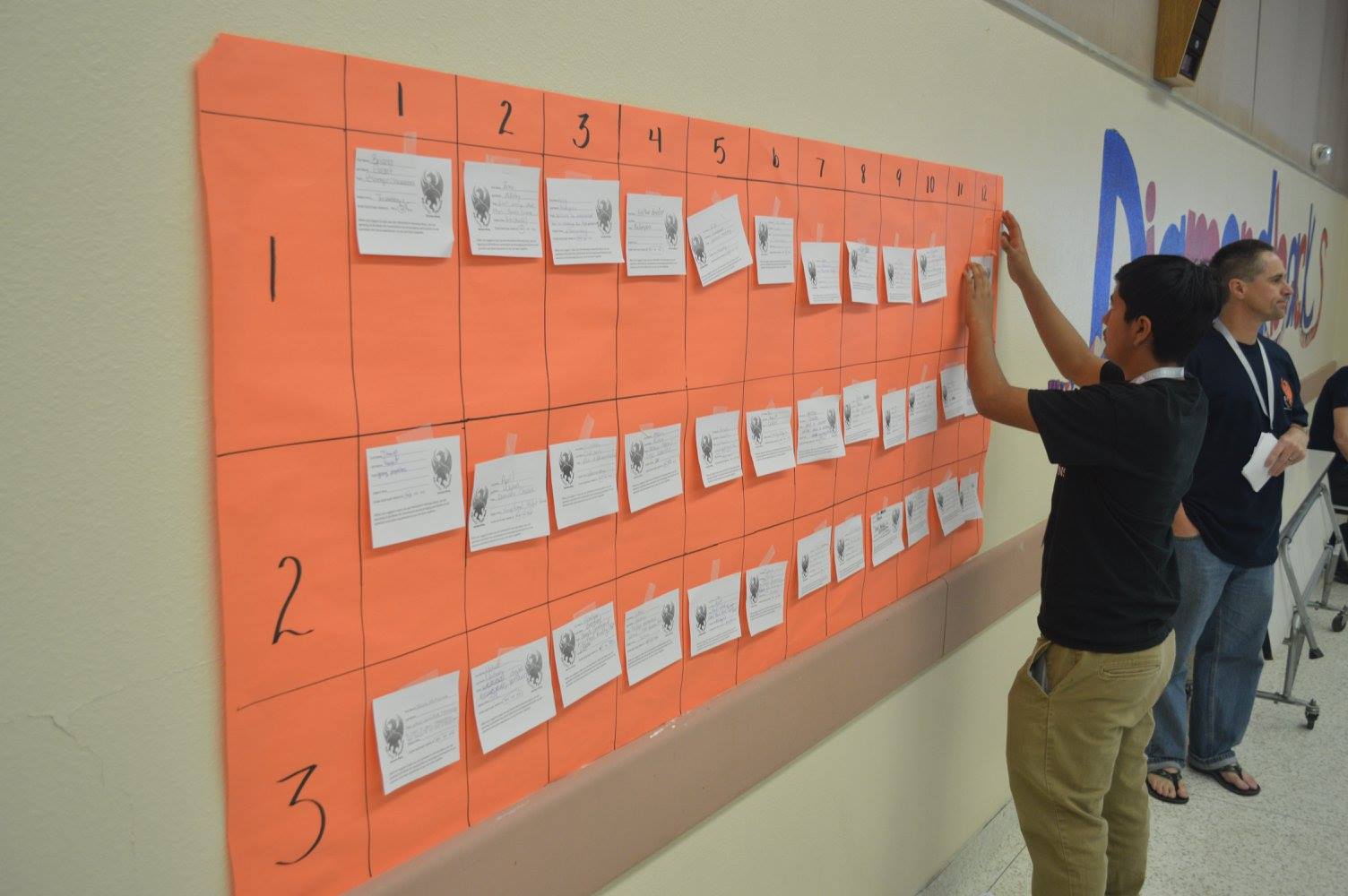
  • Another first: According to our lead session collector and organizer on the screen, Session building was easy and went super smoothly. I am usually the one talking participants through what Edcamp is at the time, so I’m not participating in the organization of the session board, but it never looks fun. So I was thrilled to hear how well it went this year. One of our ideas was that it might have been that the sessions came in slowly instead of all at once. Whatever we did, it worked well :-)
  • When I asked how many people had been to an Edcamp before, a lot of people raised their hands, which was exciting, because it is still a very foreign concept to most in our area. So, slowly but surely, we’re spreading the word.
And finally, a great list of participant takeaways from the day. Lots of positives :-)

Edcamp Phoenix 2016 Recap

Edcamp Phoenix has come and gone, and what an event it was! Participants came in to a sponsor-supported breakfast of Chompies bagels and bananas. They were grateful for a Squirrels lanyard with a 20% off coupon for Reflector 2, an app to project mobile devices to a classroom screen. Upon arrival, participants spent some time discussing in small groups what ideas created sparks for them, and began generating session ideas, which the Edcamp team assembled into our session board for the day. 

After I (Dierdre Shetler, lead organizer) explained the basic principles of Edcamp (share what you know, vote with your feet, take responsibility for your learning), participants made their way to their first sessions. Topics for the day included the following (and then some):
  • Google Classroom
  • Makerspaces
  • Digital Portfolios
  • Literacy and Assessment
  • Guided Reading
  • Building Classroom Community in Middle School
  • After-School STEM clubs
  • Socrative Seminars

While the original plan was to do 2 sessions, come back for lunch, and then finish with one more session and a sharing round, plans changed. A snafu on the part of the restaurant meant our lunch was unexpectedly an hour late! Hence, we did a quick switcheroo, and thanks to the Gumby-like flexibility of our teachers, we just went ahead and did our third session and had a lovely lunch afterward. Over a meal of taquitos, rice, beans, and excellent salsa, our participants networked and discussed our learning of the day with each other, and generally made great professional connections.

To close, participants shared their Wows, Hows, and Nows of the day (Wow-a big takeaway, How-a remaining question, Now-something to implement Monday), These were captured on a Padlet, one of our featured and modeled tools for the day. And finally, we ended with lightning round sharing of web tools, which included the likes of digital music creating sites to going on online historical adventures to creating blended learning lessons using a variety of technology tools.

All of our Lightning Round sites were collected in an editable Google Doc, where people can continue to add more to share with the group over time. This was not the only use of collaborative writing that we did. We used shared Google Docs as well to create session notes for the day. These remain a source of knowledge for those in the sessions, who can continue to add to them over time, as well as for those that wished they could be in two great sessions at once. And finally, for a little levity (because believe it or not, kids, teachers like to smile!), we had an Edcamp meme contest (via a shared Google Slides presentation), which resulted in a win for Alexis Brady, a newbie teacher but an Edcamp veteran.


And to close, a word of affirmation to one of our organizers:

"I just wanted to tell you how much fun I had a Edcamp on Saturday!  It was so informative, a great way to learn new tricks for the classroom without the boring professional development feel and it was FREE!  The day flew by!  As you know, I was a little hesitant going with me being an art teacher but I learned so much! I endorsed the Edcamp PD to my Student Achievement Teacher, my Instructional Coach and to the rest of the district art teachers, hoping to get more people to go next time!!!  Thanks again for sending out the email!"

Thanks again to our major sponsors! Without the contributions of Piktochart, Edweb.net, and Squirrels, we would not have been able to keep hungry tummies happy!

Our sponsor, Squirrels LLC, developed an affordable classroom screen mirroring app that is used in more than 100,000 classrooms in more than 200 countries. Reflector 2 is an app that runs on a teacher’s computer and receives a real-time “mirror” image of classroom iPads, iPhones, Chromebooks, Android devices, and Surface Pros.”

Monday, April 15, 2013

Edcamp Do's & Don'ts for Organizers


It can’t be that hard, right? I knew that wasn’t going to be the case, but I was still amazed at how much time all the details took. In retrospect, these are a few things that I loved, and wasn’t so in love with, about the route we took to arrive at Edcamp Phoenix 2013. 

Loved!

  • Sponsors that contacted US! (Thanks to the edcamp.wikispaces.com page!) Make sure you make a page on the wiki for your Edcamp, since this is Grand Central Station for all things Edcamp.  Many sponsors look through these pages looking for Edcamps to sponsor (6 groups contacted us) as well as potential attendees looking to see if there is an upcoming edcamp in the area.
  • Using Google for planning. We used Google’s FREE services for everything.
    • Google+ Hangouts for meetings at home
    • Google Drive for TONS of shared documents and collaboration (specifically one massive spreadsheet with a bunch of tabs covering every aspect of Edcamp)
    • Google Docs for note-taking in sessions on the day of Edcamp. They were open for anyone to contribute. Here’s one great example. Go to edcampphoenix.org for Google Doc notes, under the session tabs.
    • Google Sites for our website, edcampphoenix.org
  • Having multiple intelligences on the planning team. By including people in different fields, locations, and with different skills, we were all able to focus on areas of specialty. One person used his technical skills to create and maintain our fantastic website, develop a cool logo, and a pretty spectacular promo video called The Most Interesting Teacher in the World. Another member, a retired principal, was able to call on many of her professional contacts to help us promote the event, as well as keeping an eye toward the details of the event. A third person made it his mission to get a bank account set up, which meant setting up a non-profit. And another person ran clean up, filling in many other gaps, always volunteering for all the little things that needed doing: posters that needed to be made, organizing the registration table, etc.
  • Picking the brains of other Edcamp organizers. Twitter was a lifesaver as we debated many Edcamp issues, particularly how to go about doing the session suggestion time. When we had questions about contacting sponsors, @dancallahan was immensely helpful. Many other organizers were quick to jump in with suggestions as well, since many follow the hashtag #edcamp. (Hence, definitely tag any Edcamp twitter posts with that tag.) Blog posts about organizing the event were also immensely helpful, such as this one that nearly gave me a heartattack with all the things I needed to be doing when I found it 3 weeks before the day!
  • Unexpected sponsors. Do not assume that certain groups will sponsor and certain ones won’t. Assume nothing. The ones that seemed like a perfect fit for sponsorship, I never heard back from. The ones that seemed like a total shot in the dark, ended up being very committed sponsors, and can lead to lasting connections. My best sponsors were the ones I could explain how I used their product in my classroom or in the district, education-related or not. So contact anyone you can think of. You’ll be surprised who says yes!

Did NOT love:

  • Not enough organizers: The 5ish people who worked on our team were amazing, but we could only do so much. Next time, I’ll aim for about 8 people, who can focus on specific tasks and run with them.
  • Attrition Rate: My initial goal was 150-200 people. (I always aim high :-)) That was a bit much for the first time around, but I had no idea what to estimate, and am generally a terrible estimator. We ended up having about 125 people register, which I felt pretty good about. Either way, as I did my research, I read in multiple places to anticipate an attrition rate of 40-50%. This was very true. We ended up having about 75 attendees, which equals exactly 40% attrition. I just don’t understand how people can plan to attend something and not go. I know a few people will have things come up, but the number always boggles my mind. One tip I read online suggested emailing attendees 1-2 weeks in advance asking for any advance cancellations. This did help, as I had about 10 people cancel in advance, which helped me to give better projections for the food.
  • Session Creation time: Since I was apparently not crystal clear enough in my description of the session creation time, our people that helped consolidate session ideas into the allotted slots had a difficult time. We had a number of suggestions of things like, “Virtual classrooms” or “Retirement” that were 1) unclear/vague, and 2) had no name attached so we couldn’t ask the person what they were referring to. In retrospect, we definitely want to make 100% sure names are listed, as well as encourage people to write a 1 sentence explanation of their topic.
  • Participant misunderstanding of the purpose of Edcamp: Upon reading the evaluations, I was disappointed to see a number of people comment on the fact that there wasn’t necessarily an expert in the room on every topic. I can see how this might be frustrating, but that’s also part of the purpose of Edcamp, is that everyone can choose topics on that day, anyone can lead a session on anything, and anyone can suggest a session. Part of me wanted to respond with, “Then try a regular conference,” but at the same time, there may be ways to massage the system to help make sure the purpose is well-understood, and provide for ideas in this case. As we talked through some of this as a planning team afterwards, we decided that these were some possible suggestions for that situation:
    • Make a major point of encouraging teachers to come prepared to share on a topic
    • Use the registration form to indicate interest in topics and presenting
      Make the registration form public on website, which allows other participants to see who’s coming and what topics are of interest to people
    • Use the session time to do research together and report back your findings in 30 minutes (become experts!)
    • Have a number of people on hand who might be able to share on a wide variety of topics (specialists, etc.) who you can send out to sessions that may be big (Common Core, iPad use, etc.)

Overall though, Edcamp Phoenix was a fantastic experience. Now that it’s over, I realize how much time it was taking up, but it was 100% worth it. The enthusiasm that people had for the event was stunning to me :-) I have no doubt that next year will be even better! 


[The posters were made by our awesome, slightly bored during sessions, student volunteers :-)]

Monday, March 4, 2013

Become a Better Teacher at Edcamp

An unconference. No speakers brought in, no sessions planned in advance. Planning an Edcamp can’t be that hard, right? Ha! It turns out there are a lot more logistics than one might think.

However, when all the logistics were set up, and people began arriving on Saturday, February 23, for the first ever Edcamp Phoenix West, some might say magic happened. I however, would not call it magic. What happened is exactly what one should expect when teachers get together on their own time in their own way.

They became better teachers.

They shared ideas, successes, and perplexing issues. They wrote down others’ great ideas, websites, and names. They exchanged contact information so they can keep working together. This is what professional development should look like. We don’t have to force teachers to do this. We don’t have to pay them to do this. We don’t have to bring in an expert. They’re already here.

What did we do to encourage this kind of a gathering? We supplied a location, coffee, pizza, and prizes. That’s it. Yes, the details of coordinating all of this involved more than one meeting. But witnessing the energy, excitement, and passion for education in the building made it all worth it.

So. Do you want to be a better teacher? Do you want to engage with others passionate about their craft? Come to Edcamp Phoenix 2014. (Dates to be announced soon.)


photo credit: a.e.ray via photopin cc